
English Essay Review
Close handwritten OCR, sentence-level feedback, teacher review, and score validation into one traceable teaching workflow
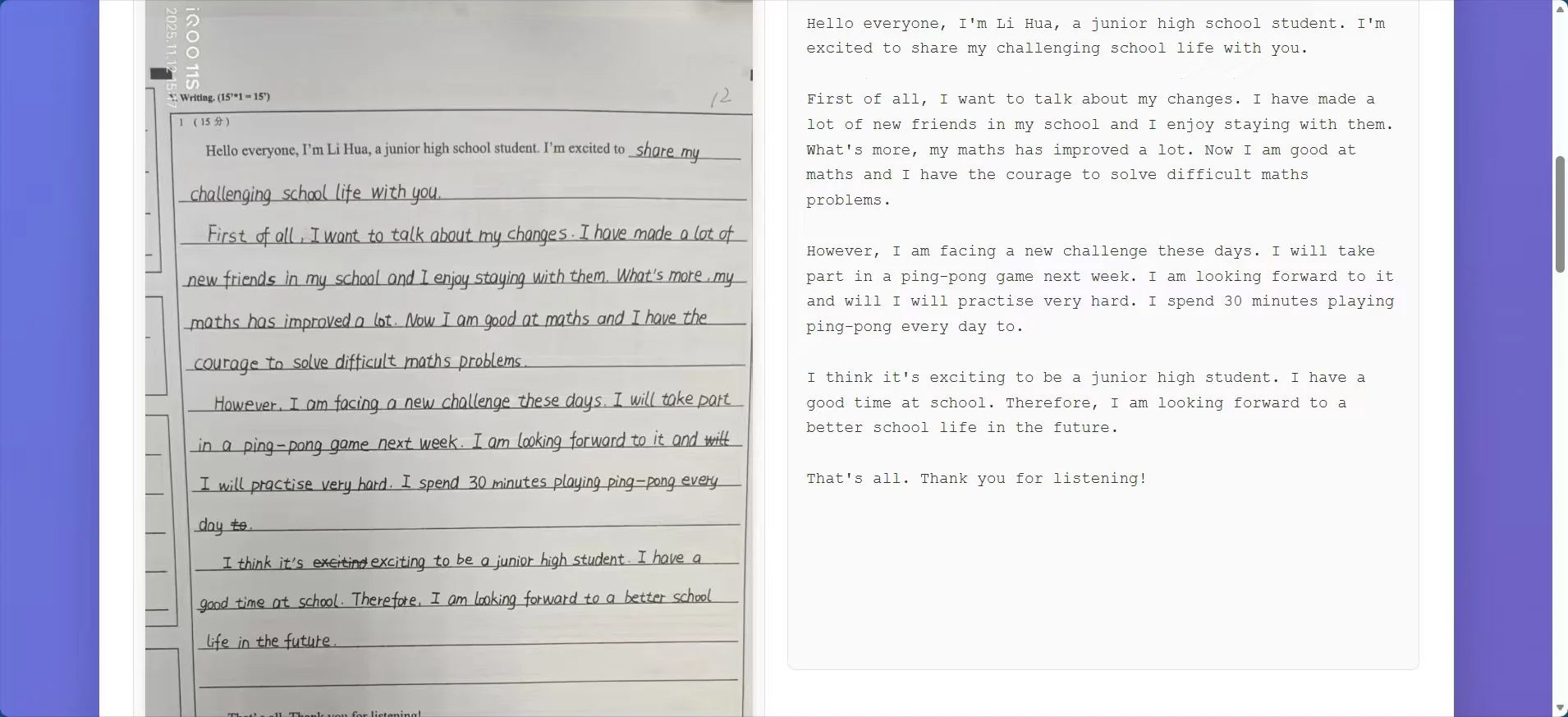
[Product demo] The input layer keeps the handwritten original and OCR text side by side, so students and teachers can check recognition and reading order before scoring.
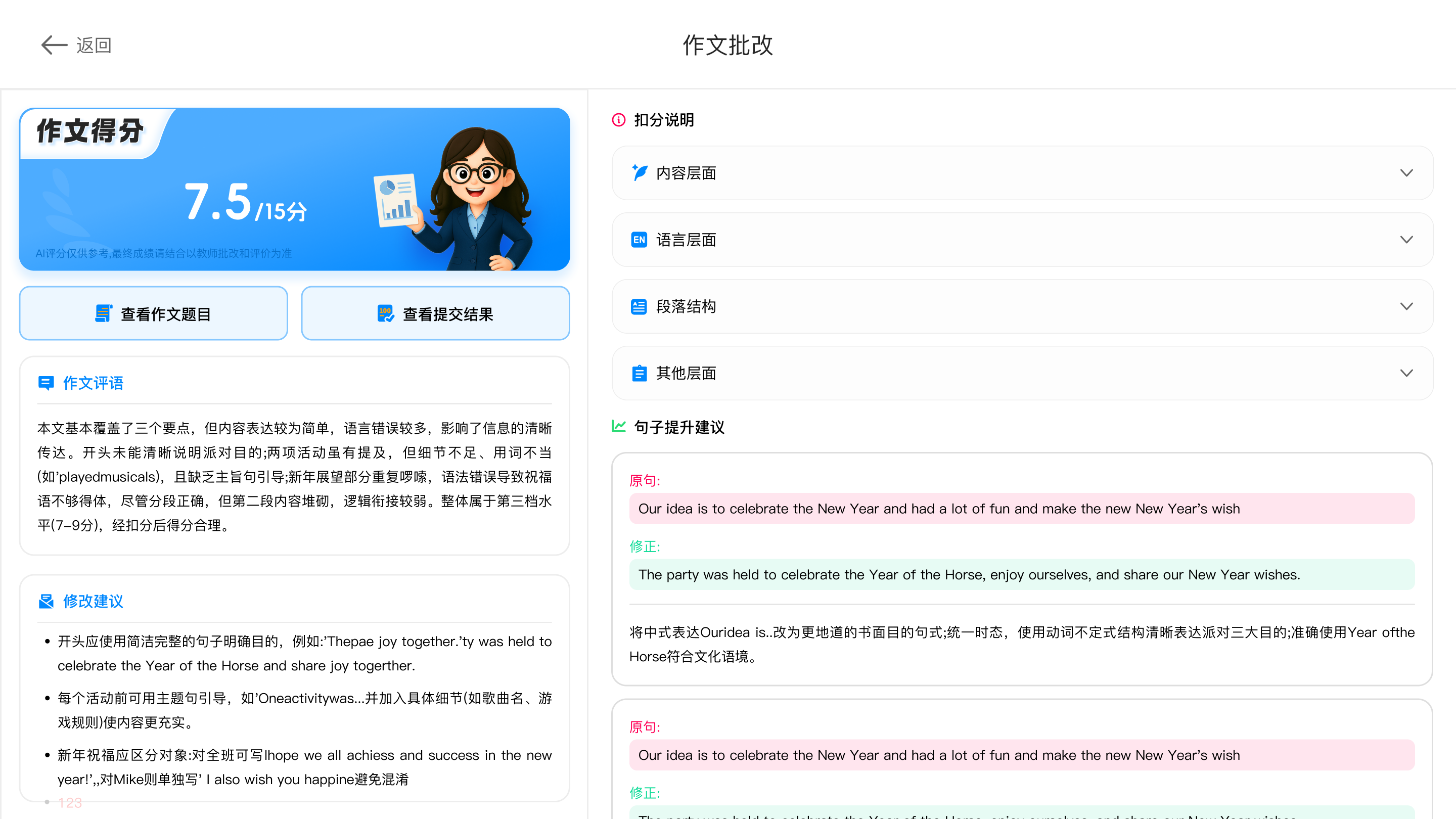
[High-fidelity prototype] The student review page first gives a reference score and overall comment — whether the main idea is clear and whether a reader can follow it — then drills into content, language, and structure deductions and sentence rewrites. The AI score is for reference; the teacher still confirms the final mark.
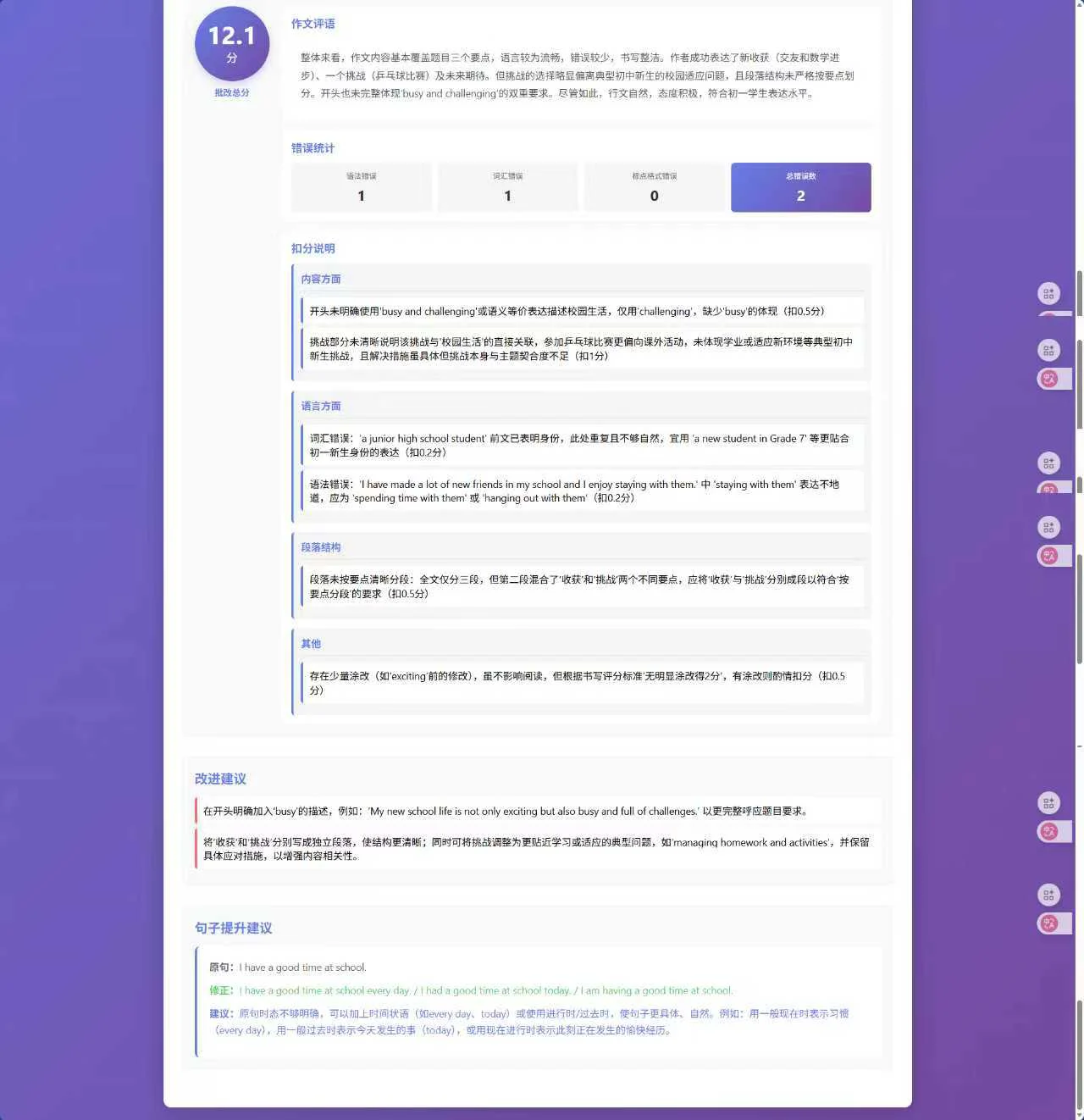
[Product demo] The student report drills from total score into content, language, paragraph structure, other issues, and sentence-level suggestions — not only telling the student what was wrong.Hover the preview and scroll to see content beyond the frame
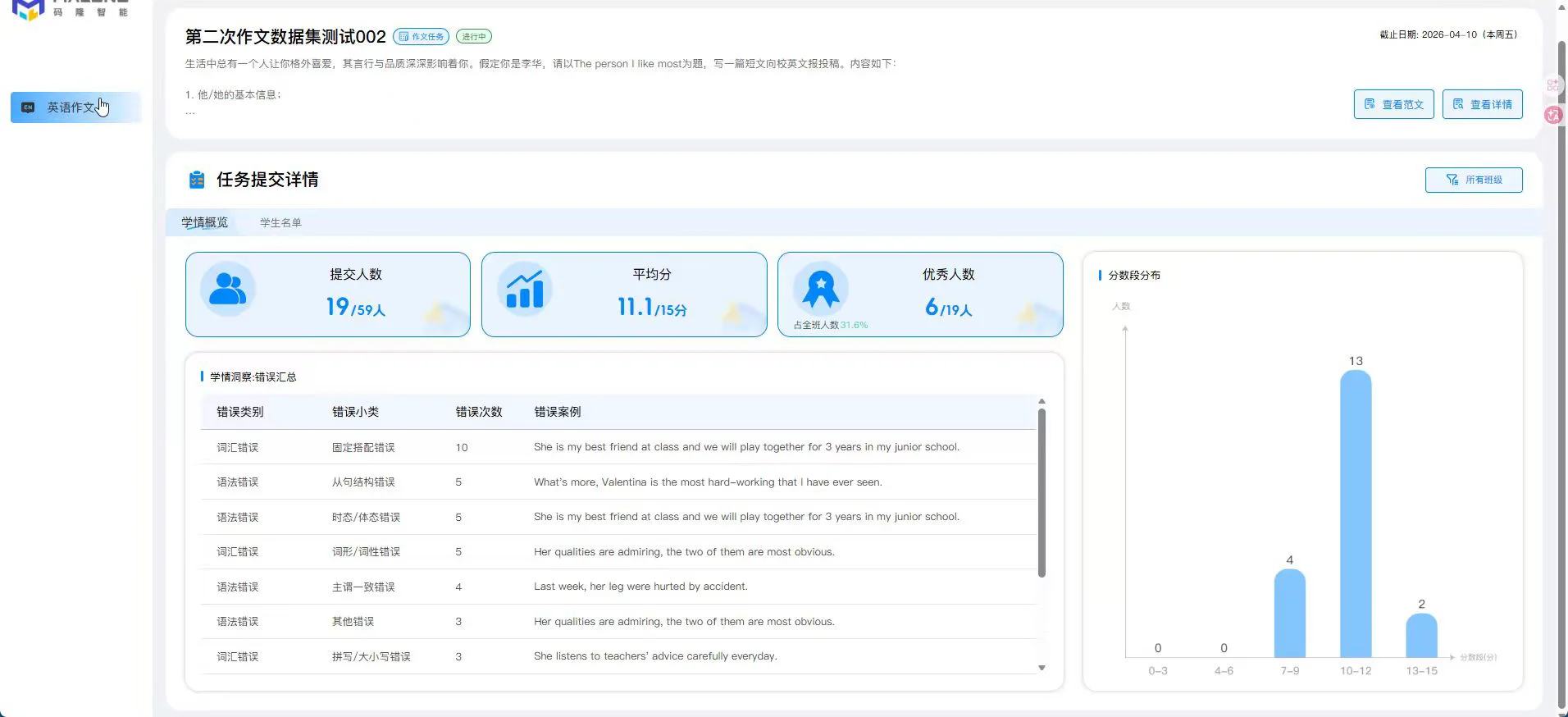
[Product screenshot] The teacher side brings AI pre-review back into teaching: teachers see submissions and distribution, check error cases, and keep the final judgment.
Why this exists
In the school partnership for the AI Learning Space, the English department of Shenzhen Foreign Language School’s junior high asked for essay and daily-writing review. Teachers said solutions they had tried generally scored high, and only marked grammar, without checking whether expression and content matched the prompt. On delivery form, other solutions also required teachers to collect every essay and photograph them page by page on a phone. On our learning-space hardware, each student can photograph and submit their own essay, which cuts a large amount of mechanical work for teachers.
After interviewing teachers, I collected how they do a close mark and which parts of an essay they attend to. I did not first write a PRD covering every ideal capability. I used vibe coding to build a working demo in 3 days, answering more basic questions first: can handwritten essays be recognized stably; can feedback land on specific sentences; can AI judge expression against the prompt; how far AI scores sit from teacher judgment; and where waiting, failure, and human takeover should appear.
The hard part of essay review is not getting a model to emit a score by rubric. It is judging whether a student can make the main idea clear in the target language, writing something a reader can follow and feel; while keeping the input checkable, the advice worth taking, exceptions traceable, and the teacher knowing when to take over.
Where essay review is hard
A final essay score depends on stacked judgments: capture and handwriting quality affect OCR; OCR text and reading order affect sentence analysis; sentence analysis affects whole-essay evaluation. Any upstream error is amplified downstream.
The object of evaluation also drifts easily. Many AI reviewers stop at the rule layer — spelling, tense, sentence form. For English writing teaching, rules are only the floor. What teachers actually look at is whether the student can express a main idea in the target language: is the meaning clear, can a reader follow, are feeling and intent conveyed. Catching only form will mark a clear, sincere essay as “full of mistakes,” and will teach students that writing equals making fewer errors.
- Input risk: connected writing, crossing-out, inserted words, and capture quality change OCR.
- Evaluation risk: AI easily treats “is it correct” as “is it good,” and misses whether the main idea is clear and whether a reader can understand and feel it.
- Judgment risk: a close overall mean does not mean every essay is reliable.
- Teaching risk: if teachers cannot review and see shared class problems, the product is still a personal tool.
Three product judgments
1. Recognition results must be checkable
The current prototype uses a multimodal large model for OCR. To keep recognition errors from silently entering scoring, the interface keeps the handwritten original and OCR text together. Teachers can first judge what the student actually wrote and whether reading order is correct, then understand the later score. What is checked is not how pretty recognition looks, but whether later evaluation is still of the student’s own expression.
2. Evaluate expression first, then rules
The student report first gives a total score and overall comment — whether the main idea is clear, whether a reader can follow, whether feeling and intent come through — then explains deductions in content, language, and paragraph structure, and drills into original sentence, revised sentence, and why. Rule issues are still marked, but they are the floor, not the center of whole-essay evaluation. The goal is not to polish a more correct essay for the student. It is to let them know whether the meaning came through, and how to say it next time.
3. AI gives a pre-review; the teacher keeps the final judgment
The teacher side summarizes submitters, average score, high scorers, score distribution, and typical cases. AI takes scanning, pre-scoring, and grouping; teachers review not only recognition exceptions and grammar, but also whether AI scored a readable, felt essay too low, or a drifted main idea too high. Personalized comments and shared class problems still decide how the teacher teaches next.
How the product is organized
Keep the original writing and crossing-out
Check whether the text is still the student’s meaning
See if the meaning is clear, then how to rewrite
Judge main idea and readability first, then language
Confirm expression judgment and see class insight
This chain separates recognition from scoring, rule checking from expression judgment, and AI output from teacher confirmation. The prototype gallery at the top follows the same order: OCR comparison, student review page, detailed report, and teacher workbench. The long report can keep scrolling inside the preview.
Score validation: a close mean is not per-essay reliability
I compared AI scores with teacher scores essay by essay on 100+ real essays. Overall, the teacher mean was about 10.22 and the AI mean about 9.91, a gap of about 0.31. That says the current approach is worth further validation. It cannot be written as “scoring is accurate.”
Human marking on a 15-point scale
Current multimodal approach
Per-essay outliers still need checking
An average can only say the system is not obviously high or low overall. It cannot reveal where a few large-gap samples went wrong.
From abnormal gaps back to OCR
Reviewing large-gap essays, the shared problem was mainly OCR, not the scoring rubric itself. When students revise, they cross out an old word and write the new one directly above. The current multimodal large model often recognizes the inserted word as its own line, scrambling original sentence order; the scoring model then analyzes the wrong text and returns a low score.
- 01Original crossing-out
The old word is crossed out; the new word is written above it.
- 02OCR splits a line
The inserted word is recognized as its own line and never returns to the original sentence.
- 03Whole-sentence order changes
Recognized text is no longer the student’s actual expression.
- 04Scoring is steered by bad input
Downstream deducts from the wrong text and returns a clearly low result.
That review closed “the model is sometimes inaccurate” into a problem that can keep being solved: handwriting layout restoration under heavy crossing-out. Original-image comparison is therefore not decoration. It is a necessary check for the current technical approach.
Current approach and next direction
A multimodal large model does OCR
Good for quickly validating the end-to-end chain, and it can understand image and text together; but with crossed-out words, insertions above the line, and complex reading order, it cannot restore the original sentence stably.
Dedicated handwriting OCR + crossing-out relations
Plan to use a dedicated handwriting OCR model and add logic that restores crossed-out words, inserted words, and reading order. Until that is done, original-image checking and teacher review stay.
Daily writing, personal growth records, and textbook-unit links belong to a fuller teaching system. They are not treated as capabilities this demo already has. This page only states the working prototype, real-sample comparison, and the failure review already done.
What I took from the project
The main takeaway is not proving “I can make a model mark essays.” It is starting from a real frontline teacher need, splitting multimodal capability into a product chain that can run and be inspected; then validating against real teacher results, not hiding outliers behind an average, and tracing the problem to the first place the input went wrong — so the next technical and product round has a clear boundary.
MY CONTRIBUTION
- Starting from a real English-department need, split essay review into original-image intake, OCR comparison, sentence-level feedback, and whole-essay scoring
- Finished a working demo in 3 days and ran human–AI score comparison on real essays; teachers accepted the result
- Reviewed large-gap samples, located OCR layout restoration under heavy crossing-out, and defined later work on dedicated handwriting OCR and restoration of crossed-out / inserted words
PROJECT OUTCOME
- Validated on 100+ real essays; overall mean differed from teacher marks by about 0.3 points, with per-essay gaps inside teacher tolerance
- Formed an end-to-end product prototype covering student review reports, teacher review, and class-level error insight
- Landed the demo flow in the actual product as a class essay board teachers can use to find shared problems
Scope note: This was a fast product validation from a real school need. After teachers accepted the result, the product function was planned and landed to close the loop. OCR is still done by a multimodal large model; dedicated handwriting OCR and restoration of crossed-out / inserted words are still planned.