
AI Homework Grading Workflow
First restore a multi-page paper into a reliable question structure, then generate marking, explanation, and knowledge-point diagnosis item by item
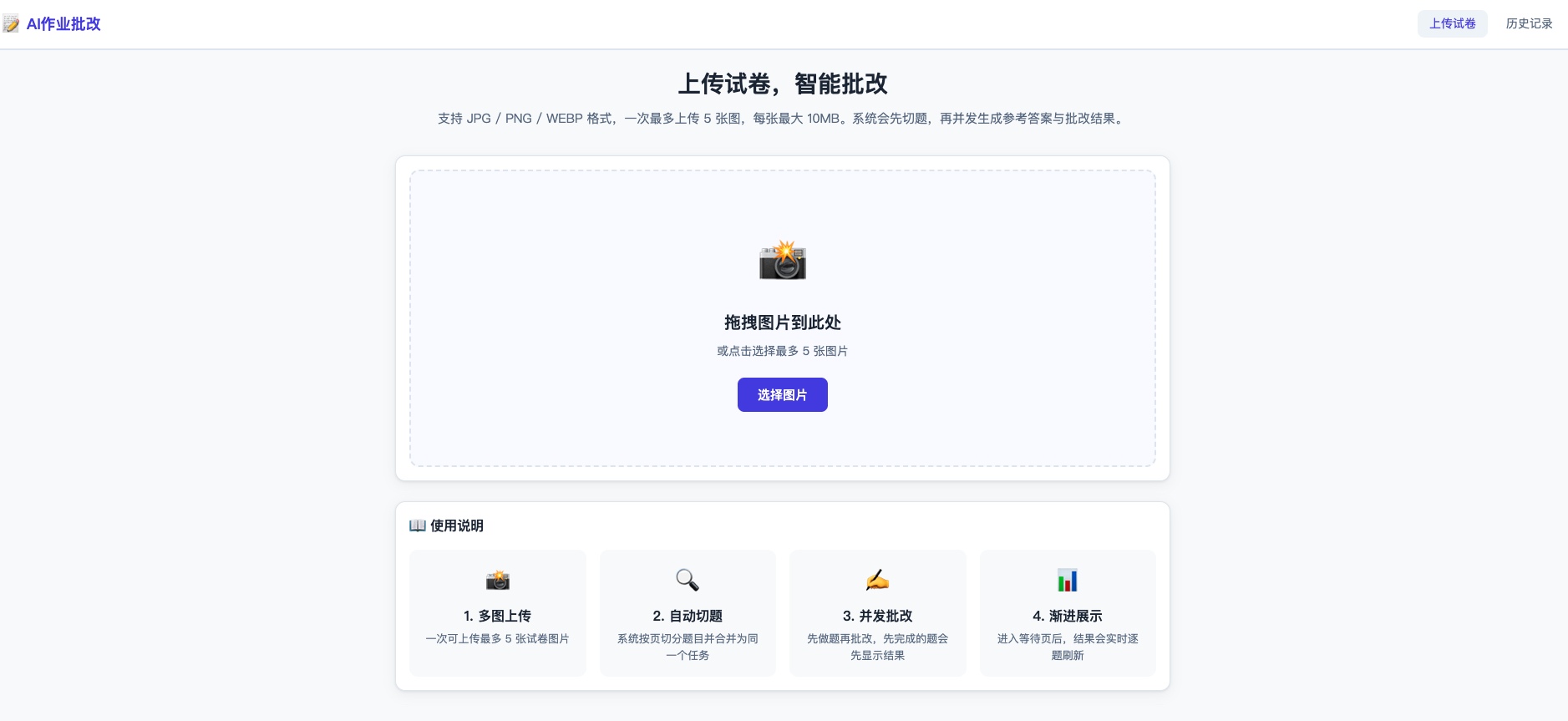
[Product demo] A marking task starts from multi-image upload. The page shows the full entry: up to 5 paper images, automatic item split, concurrent marking, and progressive display.
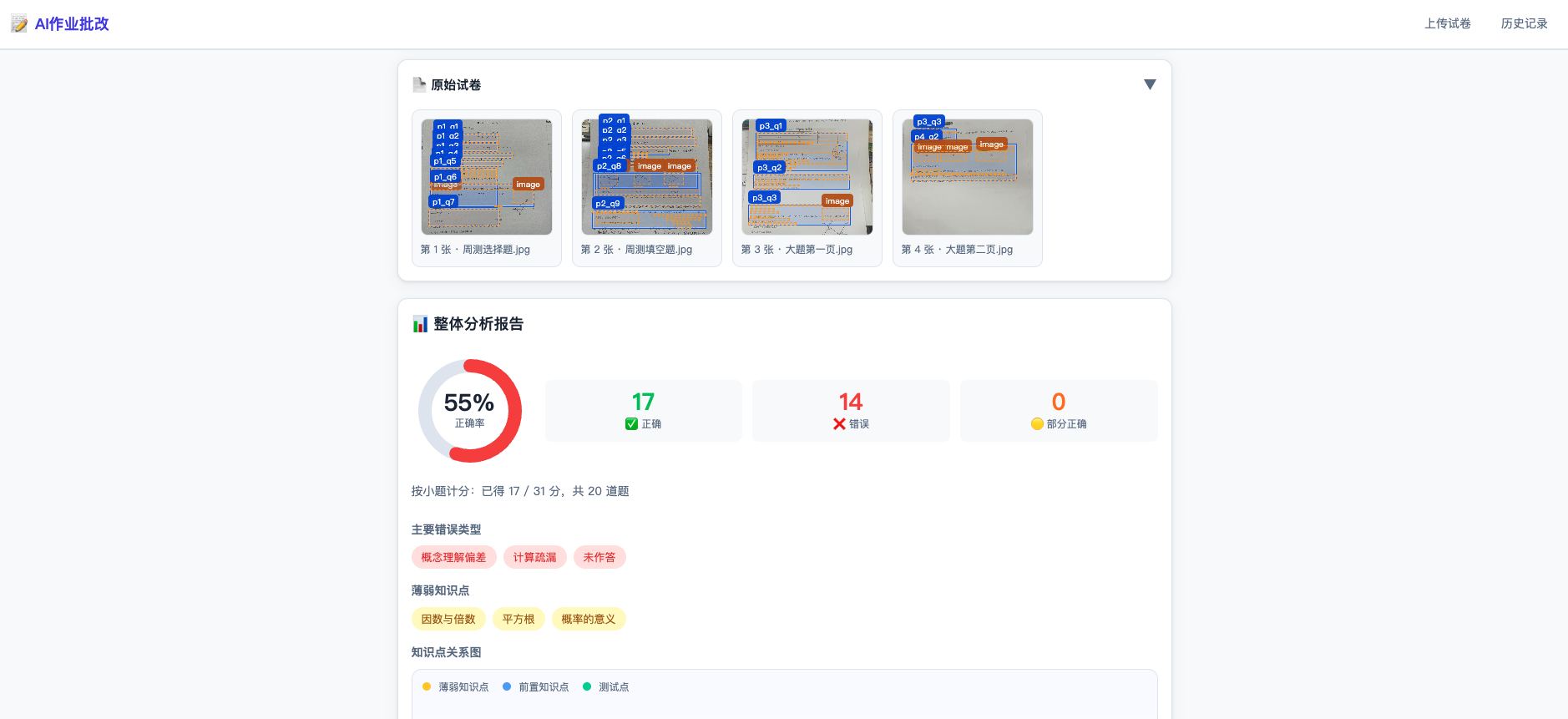
[Product demo] The original-paper area keeps structured marks for each page’s questions and image blocks, so the demo can check whether splitting is accurate. Below, accuracy, error types, weak knowledge points, and knowledge relations are summarized.
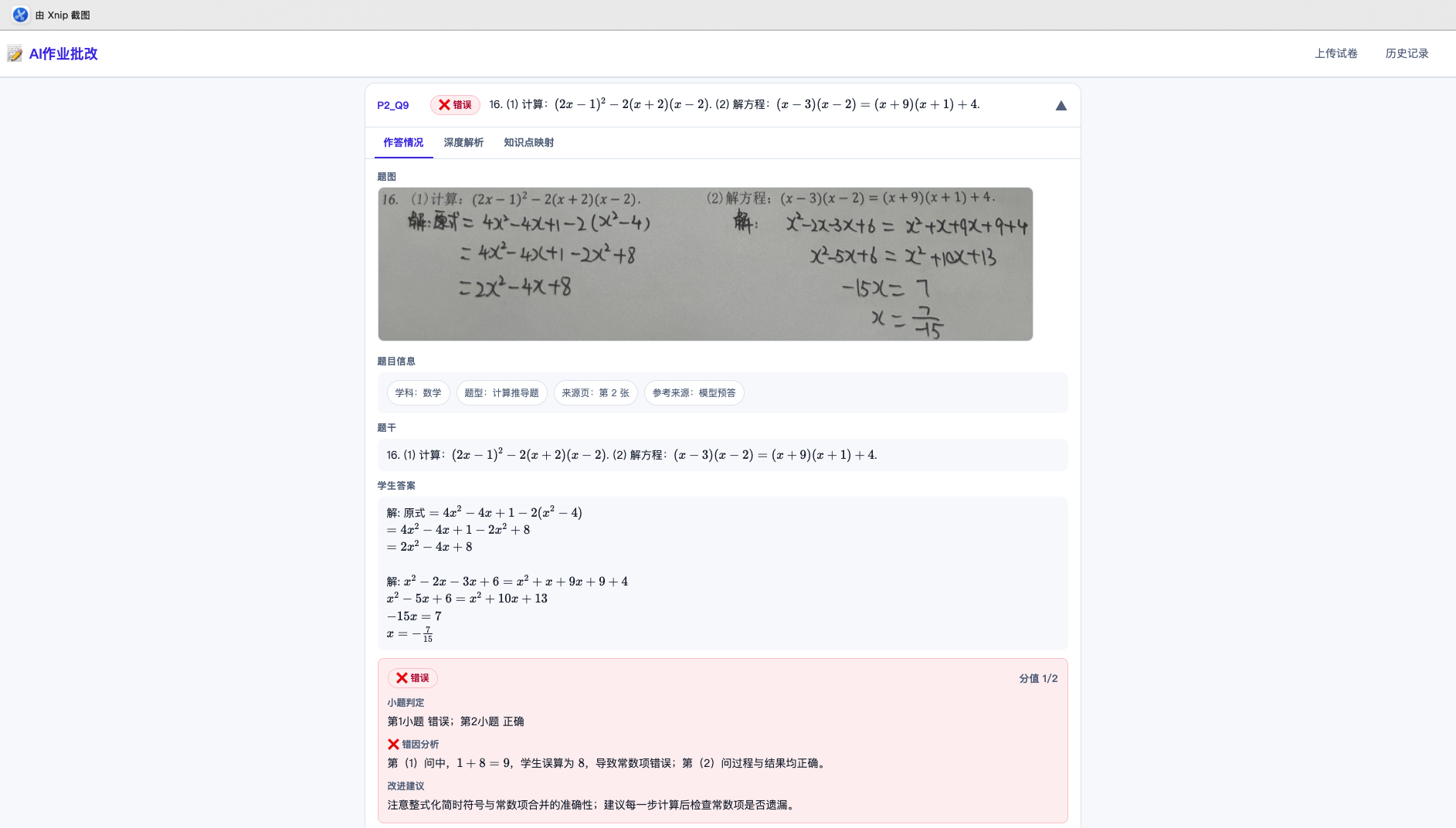
[Product demo] Compound-question detail puts the original crop, stem, student answer, and sub-item judgments in one question object, with score, error cause, and improvement advice.
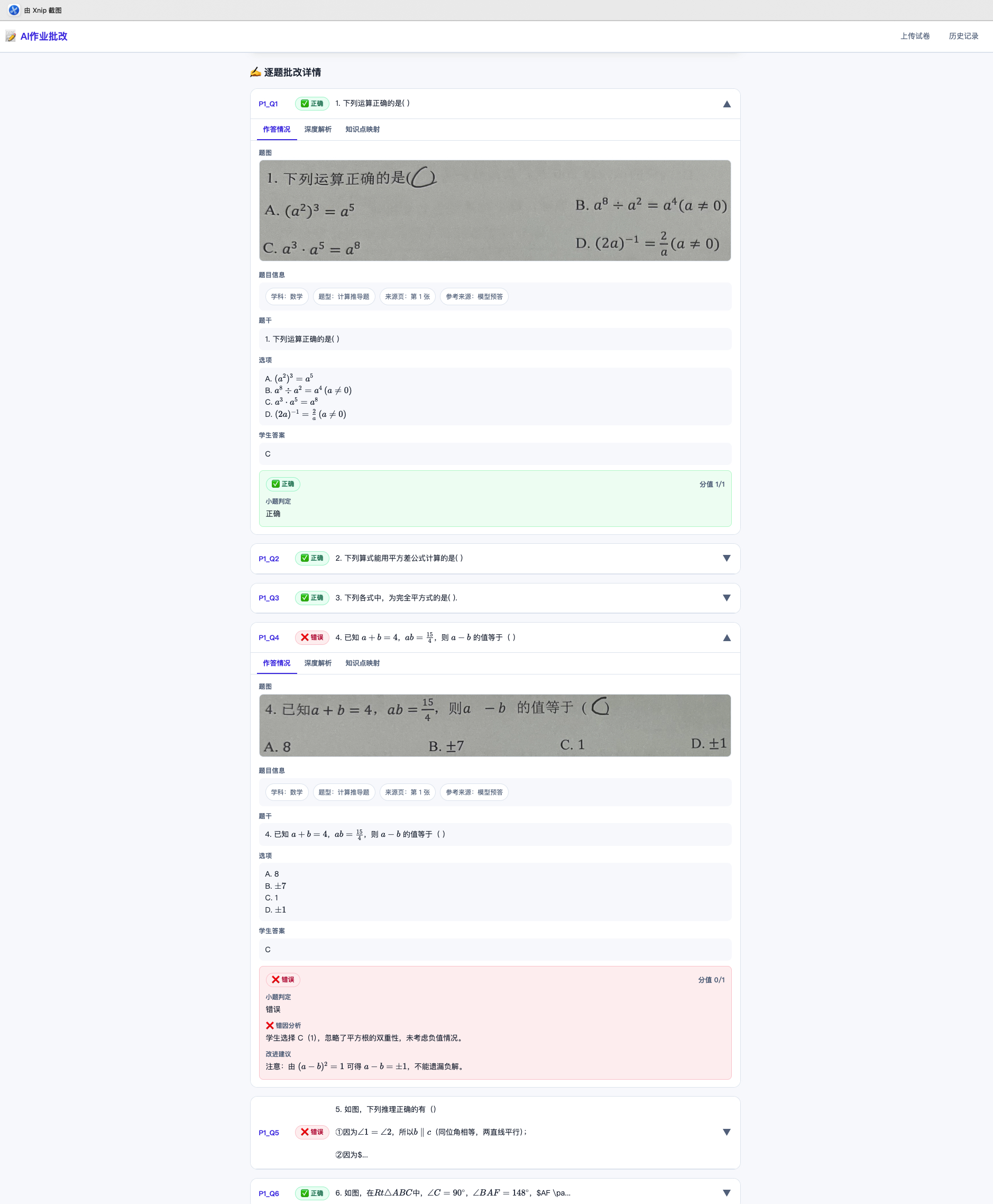
[Product demo] The per-item list can expand to show answers, deep explanation, and knowledge-point mapping. Correct, incorrect, and collapsed states can be scanned in the same report.Hover the preview and scroll to see content beyond the frame
Why this exists
Even after homework load was reduced, schools still assign work to keep teaching quality, and subject teachers still mark everything. The point of marking is not finishing the stack. It is letting teachers see the knowledge each student’s answers expose. For teachers, this is mechanical, repetitive, and still cannot be skipped.
If an AI workflow can mark homework and gather problems and error-cause analysis into a report teachers can inspect, teachers do not have to choose between “seeing learning state” and “less mechanical labor”: insight into mastery stays, and the burden can come down.
The product goal of homework marking is not replacing teacher judgment with AI. It is letting the workflow take mechanical marking, and gathering the knowledge gaps each student exposes into a report a teacher can check. Teachers keep insight into mastery, and are freed from turning every page.
First define a reliable question object
For that report to be trusted, what decides the result first is not the marking prompt. It is which question the model actually saw. A real paper is not one neat image per item: a large item may contain several sub-questions; stem and answer may cross a page; a diagram may sit far from the stem; formulas, tables, and handwriting may be split into different regions by layout models. If the upstream cut on question boundaries is wrong, later OCR, reference answers, and knowledge points keep reasoning on the wrong object, and the report looks complete while answering the wrong question.
I split what a paper has to restore into three relations:
- Question boundary: large-item numbers do the split; sub-questions, working, and student answers stay inside the same item; first and last blocks on adjacent pages have to be judged as one cross-page item or not.
- Figure–text relation: stems, tables, formulas, diagrams, and handwritten answers have to be composed in reading order, without hanging a neighboring item’s figure on the wrong question.
- Result evidence: each item stores not only a judgment, but the original crop, stem, student answer, reference source, error cause, and knowledge-point mapping, so the first wrong step can be found.
Keep source page, crop box, cross-page fragments, and figure relations.
Compound items are judged sub-question by sub-question, distinguishing correct, incorrect, and partially correct.
Solve independently first, then generate explanation and advice from the student’s answer.
Record candidates, match reasons, and evidence; abstain when unsure.
How the product is organized
I closed the demo into four sequential processing stages. Each stage produces a savable intermediate state, so problems are not only found in the final report.
Submit 1–5 paper images at once, keeping page order and originals.
Split large items, merge cross-page items, and attach figures the question depends on.
Recognize stem and answer, solve independently, then mark formally.
Generate error cause, knowledge-point mapping, weak items, and study advice.
1. Automatic splitting is not one model call. It is routing with a quality bar
The main path first cleans noise blocks through layout analysis, restores reading order, and builds candidates from large-item numbers; sub-item numbers are not mistakenly split into new large items. The system checks result quality by candidate count, coverage area, and block height: if the main path is unreliable it falls back to multimodal whole-page splitting; only if that also fails does even splitting keep the flow from stopping.
For multi-page papers, the system sends the bottom block of the previous page and the top block of the next page into a cross-page judgment; they merge only when position, number continuity, and semantic evidence all hold, and the merge reason and confidence are saved.
2. Figures cannot be associated only by “who is nearest”
When a stem says “as shown” or “as in the table,” but the current item has no matching visual block, the system recalls candidate figures from the same page and adjacent pages. A rule layer first compares page, number hints, figure type, context keywords, and spatial position, then a vision model judges among a limited set of candidates; after a high-confidence hit, the item crop is concatenated with the candidate figure and re-recognized.
This design is not “is there an image.” It is “which question does this image belong to.” If evidence is thin, the main flow keeps a missing-figure state and continues, rather than forcing a candidate that looks reasonable.
3. Per-item feedback and the whole-paper report finish separately
After splitting, each item independently goes through stem and handwriting recognition, model pre-solving, formal marking, error-cause or completion advice, and knowledge-point mapping. Items are processed concurrently; whichever finishes first returns first. Students do not wait for the whole-paper summary before seeing the first item.
The front end organizes each item as three tabs: answer status, deep explanation, and knowledge-point mapping. Compound items keep a judgment for every sub-question; when no answer is detected, the student side hides the reference answer and item analysis, so a blank answer does not become an answer-getting entry.
4. Knowledge-point mapping must be constrained by a knowledge graph
If the model freely generates knowledge-point names, the same concept can appear in several spellings and cannot be aggregated stably. I used “semantic extract → rule recall of candidates → model chooses under constraint” to map each item to a primary knowledge point and test point in the matching subject graph.
Mapping results also save confidence, match reason, and evidence spans. When evidence is thin, the system can return abstain; only high-confidence mappings enter weak-point stats. The summary layer then connects lost-score knowledge points with prerequisites and test points, giving study advice a structured basis.
Which complex paths the demo actually ran
The local task directory holds 30 completed-task snapshots, covering 364 structured questions. These records include repeated debugging and replay, so they cannot be treated as scale or accuracy metrics. They can prove the main product chain is not stuck in a PRD and a static prototype.
Question objects in completed tasks
Cross-page item results that actually appeared
High-confidence missing-figure hits
Items that produced a knowledge-point mapping
Of those, 292 items produced a high-confidence knowledge-point mapping. That number still only describes mapping state on the current local sample. It cannot be derived as mapping accuracy; formal evaluation still needs a human-labeled question–knowledge ground truth.
How failure returns to a checkable state
- 01Layout service unavailable
Fall back to multimodal whole-page splitting; if that still fails, use even splitting as a last resort and keep the source for later investigation.
- 02No standard answer
Let the model solve independently first as a reference, then compare with the student answer; the reference source is saved with the result.
- 03Thin knowledge-point evidence
Allow abstain, so low-confidence results do not enter weak-point stats.
- 04Student did not answer
Keep an unanswered judgment, but hide the reference answer and deep analysis on the student side, so feedback does not change answering behavior.
Results and limits
This demo has validated that multi-image upload, paper structuring, cross-page merge, missing-figure matching, per-item concurrent marking, progressive SSE return, knowledge-point mapping, and a summary report can form an end-to-end chain. It also made clearer that a formal product cannot replace process quality with “the final answer looks correct.”
The current version is still single-tenant product validation on local JSON storage: no account and permission system, no class management or teacher-review workbench, and no long-term knowledge profile across assignments. Marking, splitting, and knowledge-point mapping still need separate human-labeled sets to evaluate error boundaries, high-confidence false calls, and fallback paths — not only overall average accuracy.
What I took from the project
This experiment made me recast AI marking from a “large-model capability question” into an observable product chain: once input structure is wrong, every later model can keep giving a reasonable explanation on the wrong object. What product design actually has to do is make question boundaries, figure–text relations, reference sources, mapping confidence, and failure fallbacks all visible, so a problem can be traced to the first place it went wrong.
MY CONTRIBUTION
- Split multi-page papers into traceable question objects, with large-item splitting, cross-page merge, missing-figure matching, and multi-level fallbacks
- Organized pre-solving, formal marking, error-cause analysis, and progressive return into a per-question processing chain
- Added candidate constraints, confidence, evidence, and abstain to knowledge-point mapping, so the model cannot freely invent labels
PROJECT OUTCOME
- Completed an end-to-end demo supporting 1–5 image inputs, per-question concurrent processing, and progressive SSE display
- 30 locally saved completed-task snapshots cover 364 structured questions, including cross-page items and missing-figure matching
- Connected 9 junior-high subject knowledge graphs, forming question mapping, weak-point stats, and prerequisite-knowledge display
Scope note: This is product validation and a local demo, not described as a production system. Task snapshots include debugging and reruns. They prove functional paths were actually run, not marking accuracy or scaled use.